Dolomite combines lending, borrowing and trading under asset-specific limits.
Dolomite combines a crypto lending market with trading, using deposited balances and separate borrow positions governed by asset-specific limits. Deposits can support lending income, while eligible collateral backs loans. Its virtual liquidity system records balances inside the protocol, and market caps can block new deposits or additional borrowing.
Key takeaway: Available liquidity does not override an asset cap, and a valid deposit may still be unsuitable as borrowing collateral.
Lending, borrowing and strategy choices
A supplied balance can earn lending interest without a loan, while a borrow position commits eligible collateral against debt. Swapping changes asset exposure, and curated strategies combine borrowing with yield or exposure goals. These choices draw on the same protocol accounting, although their asset restrictions and commitments differ.
| Option | Main function | Asset custody and control |
|---|---|---|
| Supply for lending | Earn lending interest on a borrowable asset | Protocol-held balance; withdrawals require available liquidity |
| Collateralized borrowing | Borrow against an eligible position | Position collateral secures debt and remains subject to liquidation |
| Balance swap | Exchange supported supplied assets | Authorized trading contracts update protocol balances |
| Curated borrowing strategy | Combine borrowing with yield or exposure objectives | Strategy positions hold collateral and debt under protocol rules |
| Integrated yield asset | Retain supported native rewards or functions | Asset-specific vault and redemption rules apply |
| veDOLO lock | Obtain governance voting weight | DOLO stays locked; early redemption carries applicable fees |
Wallet balances and virtual liquidity
A wallet balance holds tokens outside the protocol; a Dolomite Balance records supplied assets in its accounting system. Deposits move supported assets into protocol custody. Internal transfers change account balances without sending tokens back to a wallet. This virtual liquidity lets supported functions share deposited funds through ledger updates. A positive account balance represents supply, while a negative balance represents debt. Borrowed value can remain within the protocol for trading or other supported actions. A wallet withdrawal needs available token liquidity. Internal accounting changes also occur on-chain, even without an external token transfer.
Asset caps and available borrowing
An asset cap restricts the size of a market, so unused liquidity alone cannot establish permission to expand it. A supply cap limits the total supplied amount for an individual market. It applies across that market rather than granting each wallet a separate allowance.
Where the deployment supports a separate borrow cap, that setting limits the market’s total outstanding borrowing. Supply capacity and borrow capacity therefore answer different questions. Neither cap states how much a particular position can safely borrow.
When a capped total already exceeds its limit, the core permits eligible operations that reduce that total or leave it unchanged. Repayment can reduce borrowing, while withdrawals can reduce supply. Other checks still govern those operations, including available liquidity and position health.
Cap interfaces differ by deployment. The Arbitrum core exposes its supply cap through getMarketMaxWei; other core deployments expose separate supply-cap and borrow-cap getters. A market in closing mode also rejects increases in outstanding borrowing. Read the selected market’s configured limits alongside its available borrowing amount, because those values describe separate constraints.
Collateral and separate borrow positions
A borrow position needs eligible collateral whose adjusted value satisfies the applicable debt requirement. Deposited assets do not automatically secure every loan. Separate positions keep collateral and liabilities partitioned, allowing distinct borrowing arrangements within one wallet. Liquidation acts on an unhealthy position, although separate positions can still share exposure to the same asset prices or protocol risks.
Collateral-only assets cannot support new borrowing of those assets themselves. On deployments with Borrow-Only mode, a listed asset can serve as debt without qualifying as collateral. Isolation Mode adds asset-specific vault rules and restrictions on permitted combinations. These controls describe different constraints, so an isolated borrow position and an Isolation Mode asset are different concepts.
The health factor expresses whether adjusted collateral covers the required debt backing. Falling below 1 makes a position eligible for liquidation. Applicable risk settings can differ by asset composition, so a single loan-to-value percentage cannot describe every position.
Which assets can Dolomite accept on a selected network?
Dolomite accepts assets through listed markets on the selected network, with each market tied to a particular token contract. Its deployments include Arbitrum, Berachain and Ethereum. Market inventories and supported actions differ across networks, and a token ticker does not identify its contract or wrapper. Broad token support describes the architecture’s flexibility; it does not mean every wallet asset has an available market.
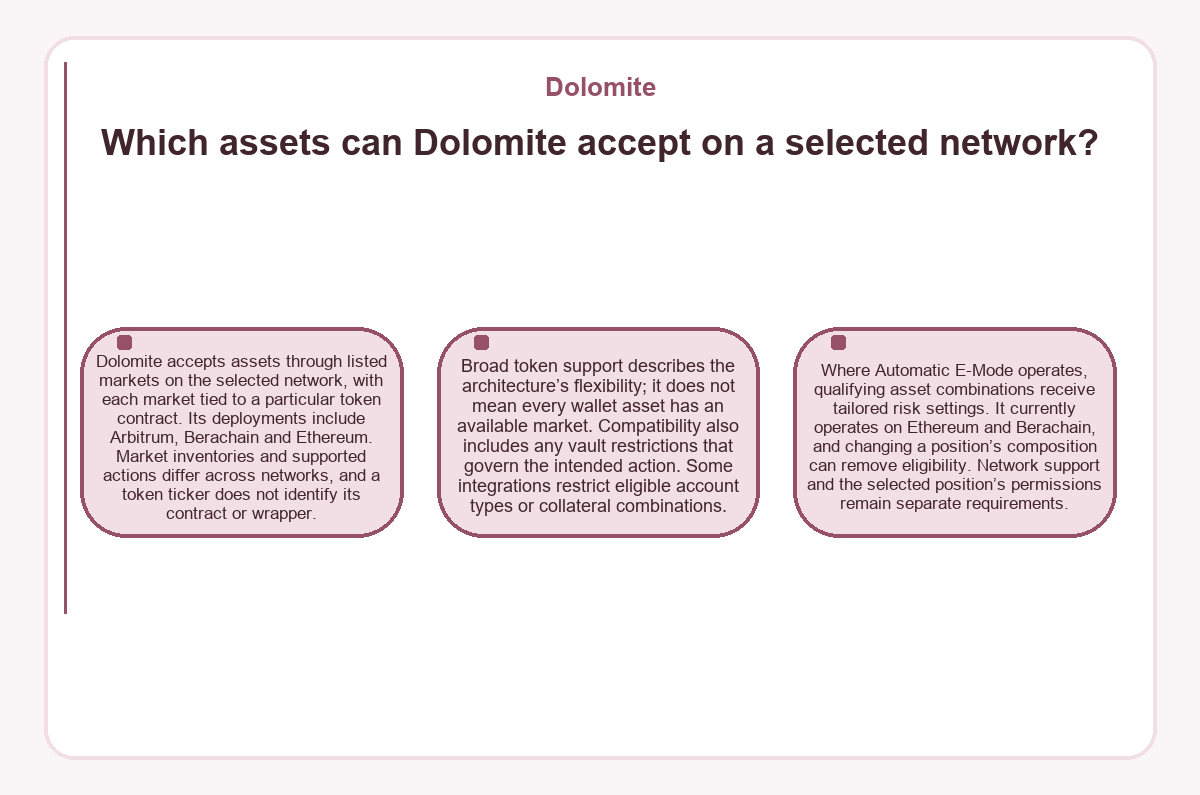
Compatibility also includes any vault restrictions that govern the intended action. Some integrations restrict eligible account types or collateral combinations. Where Automatic E-Mode operates, qualifying asset combinations receive tailored risk settings. It currently operates on Ethereum and Berachain, and changing a position’s composition can remove eligibility. Network support and the selected position’s permissions remain separate requirements.
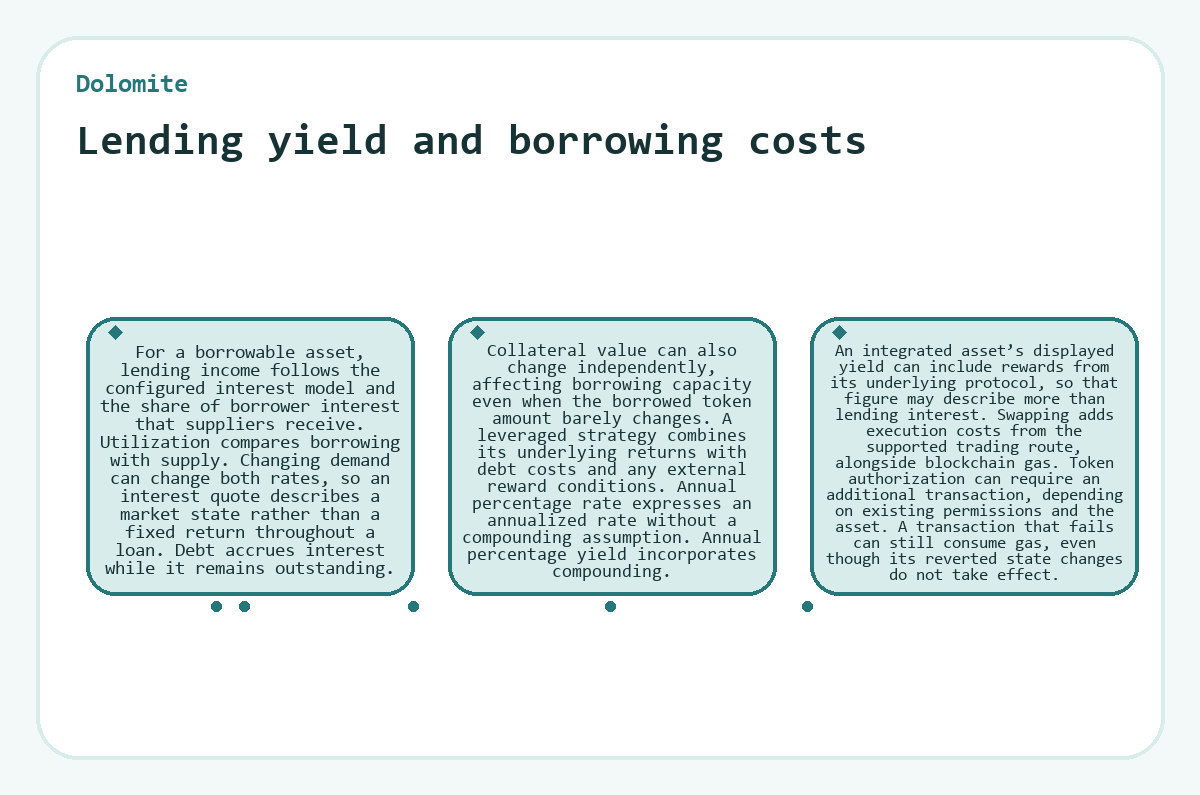
Lending yield and borrowing costs
For a borrowable asset, lending income follows the configured interest model and the share of borrower interest that suppliers receive. Utilization compares borrowing with supply. Changing demand can change both rates, so an interest quote describes a market state rather than a fixed return throughout a loan.
Debt accrues interest while it remains outstanding. Collateral value can also change independently, affecting borrowing capacity even when the borrowed token amount barely changes. A leveraged strategy combines its underlying returns with debt costs and any external reward conditions.
Annual percentage rate expresses an annualized rate without a compounding assumption. Annual percentage yield incorporates compounding. An integrated asset’s displayed yield can include rewards from its underlying protocol, so that figure may describe more than lending interest.
Swapping adds execution costs from the supported trading route, alongside blockchain gas. Token authorization can require an additional transaction, depending on existing permissions and the asset. A transaction that fails can still consume gas, even though its reverted state changes do not take effect.
Zap swaps and leveraged strategies
Zap connects protocol balances and borrow positions to supported trading routes, including decentralized exchange aggregators and direct integrations. It can combine swaps with collateral changes or debt repayment when the chosen assets and route permit them. Minimum-output checks prevent a swap from completing below the accepted output threshold.
Curated strategies package positions around yield, rewards or asset exposure. A looping strategy borrows against collateral and uses borrowed value to increase exposure. Increased exposure also magnifies adverse price movements, while borrowing costs continue to accrue. Available strategy inputs still need to satisfy market caps and position rules.
For contract integrations, the core also supports flash borrowing from markets outside Isolation Mode without an origination fee. The operation must finish with valid collateralization. This short-lived use of liquidity differs from an ongoing loan, and blockchain execution still requires gas.
Integrated rewards and DOLO governance
An integrated asset can retain supported external rewards or voting functions while participating in protocol borrowing. Asset-specific vaults connect those functions to the supplied balance. Support varies by integration, including its staking, redemption and reward rules. An asset that nobody can borrow may still generate yield through its underlying protocol.
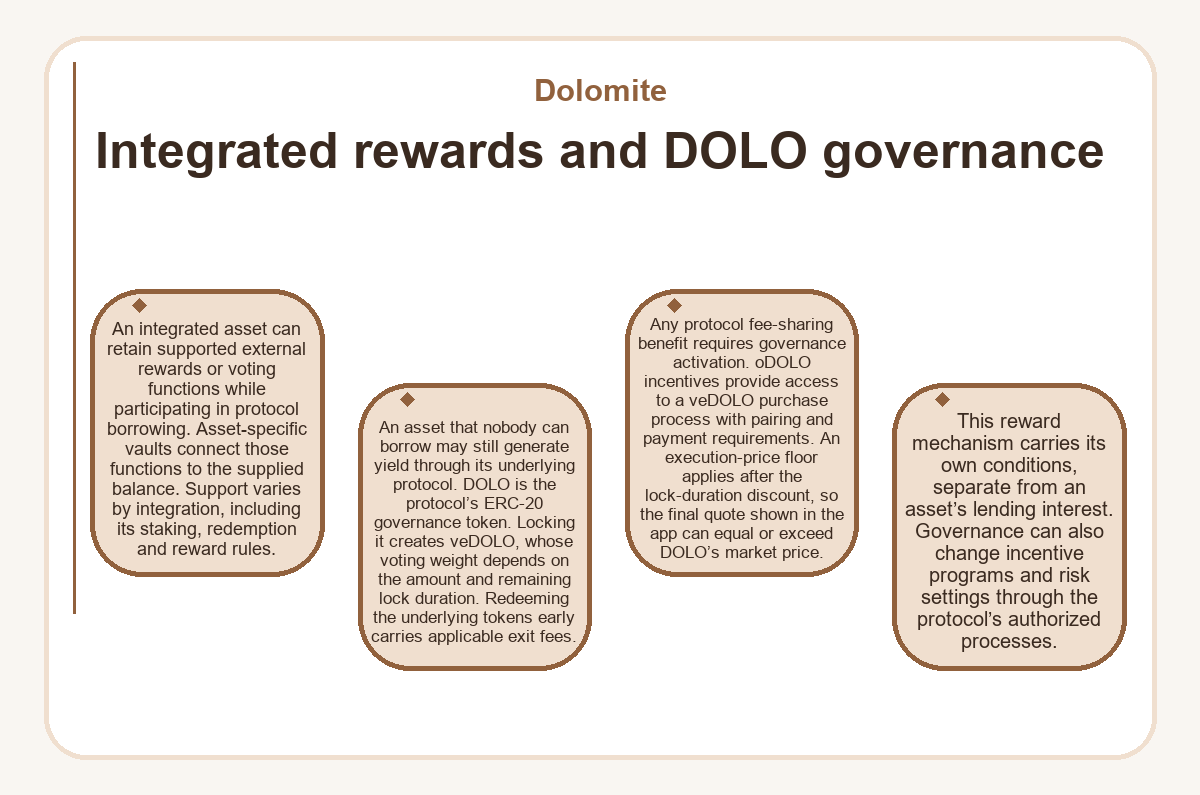
DOLO is the protocol’s ERC-20 governance token. Locking it creates veDOLO, whose voting weight depends on the amount and remaining lock duration. Redeeming the underlying tokens early carries applicable exit fees. Any protocol fee-sharing benefit requires governance activation.
oDOLO incentives provide access to a veDOLO purchase process with pairing and payment requirements. An execution-price floor applies after the lock-duration discount, so the final quote shown in the app can equal or exceed DOLO’s market price. This reward mechanism carries its own conditions, separate from an asset’s lending interest. Governance can also change incentive programs and risk settings through the protocol’s authorized processes.
Smart-contract permissions and withdrawal liquidity
Deposited assets sit in smart contracts or asset-specific vaults, where permissions and risk rules govern their use. The core code is immutable, while some modules, including vault implementations, are upgradeable. Administrators can change permitted configuration and authorize operator contracts. A global operator can act across user accounts, making that authorization a material part of the control model.
Withdrawals need enough available liquidity in the relevant asset. A debt-free position no longer needs collateral to secure its loan, but returning tokens to a wallet can still depend on vault redemption rules. Supplying an asset creates a protocol balance; it does not reserve an equal quantity of immediately withdrawable tokens for that wallet.
A redemption pause in an underlying protocol can leave its integrated asset unavailable for immediate withdrawal.
Questions people ask about Dolomite
Do I need to lock DOLO before borrowing?
A veDOLO lock is not a prerequisite for an ordinary collateralized loan. Borrowing eligibility follows the selected market’s rules and the position’s collateral requirements. Locking DOLO creates governance voting weight and can qualify a wallet for separate incentive features.
What does a zero supply or borrow cap mean?
In contract cap fields that use this convention, zero means no configured maximum for that field. It does not mean zero liquidity or unlimited borrowing permission for each wallet. Available funds, market closing status and position health still constrain operations. Separate borrow-cap fields are not available on the Arbitrum core.
Are native limit orders available in the redesigned Dolomite app?
Native limit orders remain in development following governance approval on April 1, 2026. Available spot swaps and position-management trades are separate features, with their own supported routes and execution conditions.
Does a borrow-fee rebate lower the quoted interest rate?
Borrow-fee rebates reimburse eligible interest afterward and leave the quoted annual percentage rate unchanged. The phased rollout covers only Berachain borrowing. Eligibility uses veDOLO voting weight held by or delegated to the borrowing wallet. Rebates pay in the same asset as the interest, and borrowers must claim them rather than receiving an automatic rate reduction.
Can a borrow position receive a forced expiry date?
Some Isolation Mode markets can assign an expiry when collateral approaches maturity or an asset enters final settlement. After the assigned deadline passes, the position can become eligible for liquidation despite otherwise adequate collateral. Forced expiry is a rare asset-specific settlement mechanism, separate from normal health-based liquidation, so the deadline matters alongside the position’s collateral ratio.
How do I fully repay a Dolomite loan, including interest?
The current debt balance includes accrued interest, while the original borrowed amount excludes later accrual. Contract interest indexes convert stored principal into the amount owed at the current time. Transfer each owed asset from your Dolomite Balance into the borrow position to cover its updated debt balance, including small remaining fractions. Confirm that every debt balance is zero.
Is a veDOLO lock transferable before it matures?
A veDOLO lock is represented by a transferable non-fungible token. Moving that token transfers the lock; it does not unlock the underlying DOLO or remove its remaining duration. The token mechanics also support merging and splitting locks. Redeeming DOLO before expiry is a different action that carries applicable early-exit fees.
Updated on